Climate policy is health policy: it should not be viewed solely as an environmental issue
Lowitja Institute urges the Australian Government to place Aboriginal and Torres Strait Islander peoples at the heart of climate and health negotiations and policy reform at COP31 and beyond.
Climate change is not merely about reducing emissions: it is about what kind of society we build through that transition – whether we reproduce existing inequities or use this moment to create healthier, fairer, and more sustainable systems. Climate policy is ultimately about power, who makes decisions, whose knowledge is valued, whose interests are protected, and who carries the costs of transition and adaptation.
Conference of the Parties, also known as COP, is a key vehicle through which international climate policy is developed and implemented. The Australian Government holds the Presidency of Negotiations for COP31 (held in Türkiye from 9–20 November 2026), which puts Australia in a privileged and influential position to shape political and technical negotiations and climate action outcomes on a global platform. With this privilege comes great responsibility to Aboriginal and Torres Strait Islander peoples who call Australia home.
Aboriginal and Torres Strait Islander peoples (as with Indigenous peoples globally), have contributed the least to climate change, yet our peoples and communities bear the impacts disproportionately. With COP31 underway, we have released a policy statement to continue our advocacy for our peoples to sit in the driver’s seat of climate and health policy.
Lowitja Institute strongly urges the Australian Government to embed Aboriginal and Torres Strait Islander leadership, voices, and ways of knowing, being and doing into climate and health policy negotiations, actions, and outcomes. Failure to do so at COP31 or elsewhere will continue to undermine Aboriginal and Torres Strait Islander leadership, self-determination, and better climate and health outcomes for our communities.
With that said, Lowitja Institute reaffirms calls for the Australian Government to:
- embed Aboriginal and Torres Strait Islander leadership and shared decision-making at the centre of climate and health policy.
- invest in Aboriginal and Torres Strait Islander-led climate, health, and Country-based initiatives.
- take action – climate action that respects human rights and achieves equitable health and environmental outcomes is urgently required. The climate crisis is already disproportionately affecting the health and wellbeing of First Peoples. We need to address existing inequities and ensure future action (or inaction) does not perpetuate these inequities.
- value and centre our knowledges and rights as First Peoples – Aboriginal and Torres Strait Islander peoples have protected Country for millennia and have survived dramatic climatic shifts. We are intimately connected to Country and our knowledges and cultural practices hold solutions to the climate crisis.
- work with us – communities need dedicated resources and support to protect Country and implement adaptation, and we need equitable access to housing, renewable energy solutions, and our lands and waters to protect Country.
- prioritise a movement for climate justice – climate change affects us all , but some of us more so than others. Climate change is an opportunity to reset out relationships for the better and seek a health and just future for all peoples. We need to ensure climate action (or inaction) learns from the past and does not perpetuate existing inequities.
Our work has included bringing Aboriginal and Torres Strait Islander leaders, researchers, and organisations together through climate and health roundtables; developing research and policy evidence; advocating for a national Aboriginal and Torres Strait Islander climate and health coalition; and engaging nationally and internationally, including through the United Nations and COP processes.
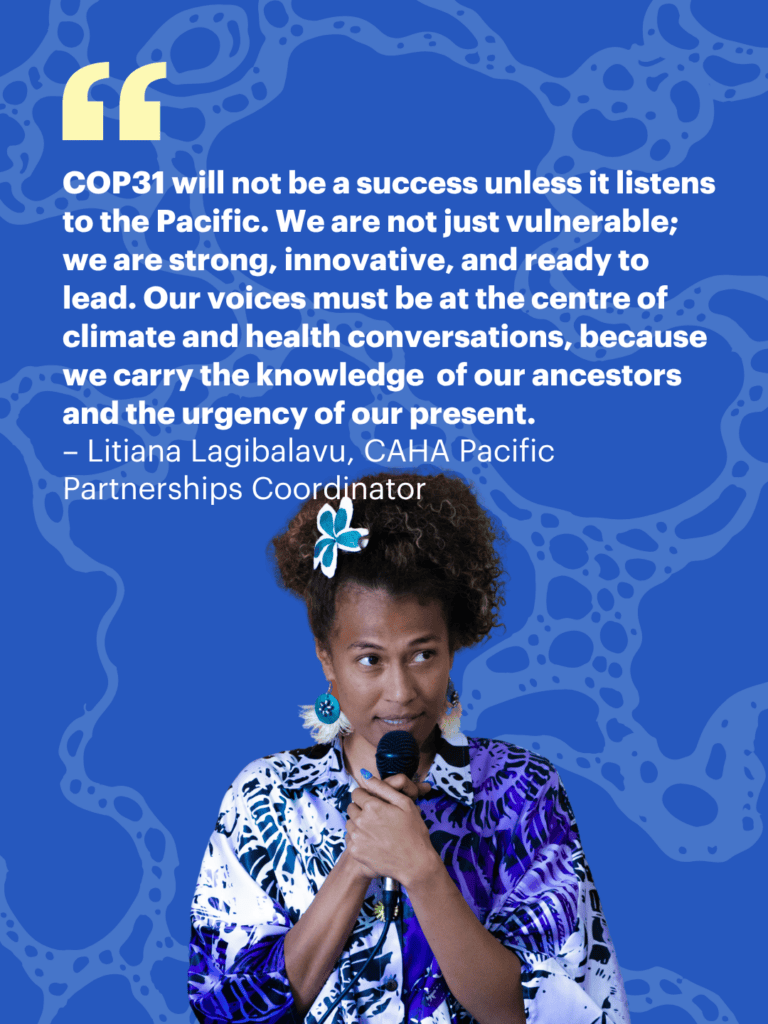
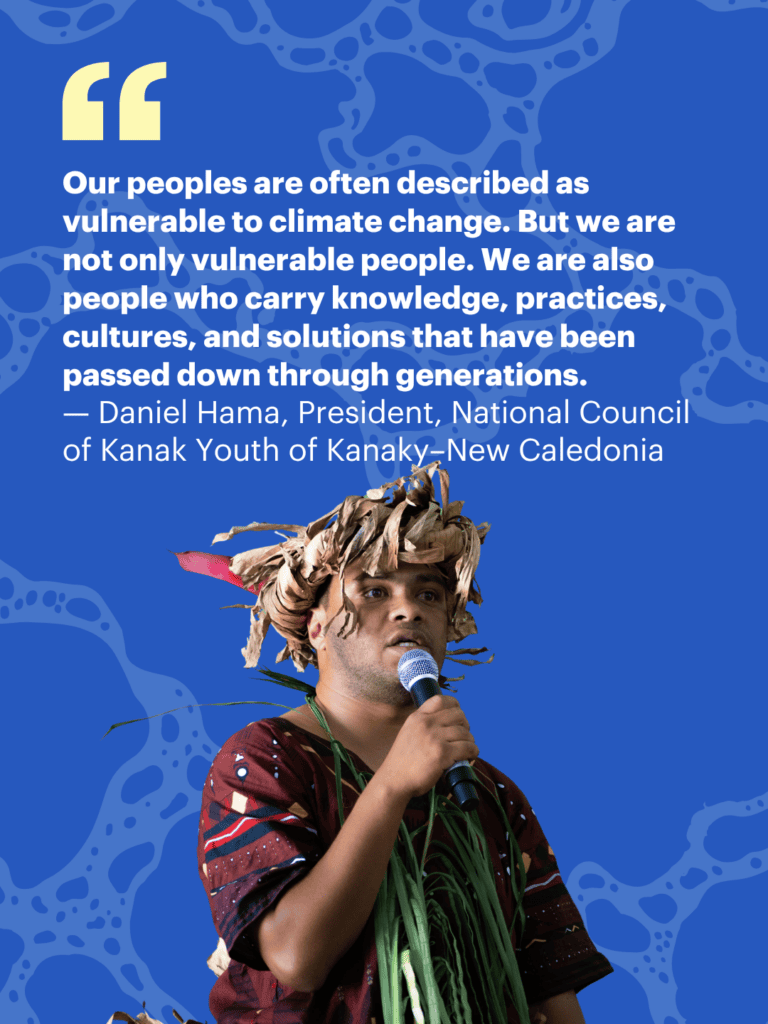
We are also building relationships with Indigenous peoples internationally, recognising that climate change crosses borders and that First Nations peoples globally share both experiences of its impacts and knowledge that can contribute to solutions. Aboriginal and Torres Strait Islander peoples share similar experiences of climate and health impacts with Pasifika communities. Therefore, we also know that there are collaborative synergies and areas of alignment between our respective communities that could underscore future collaboration on climate and health initiatives.
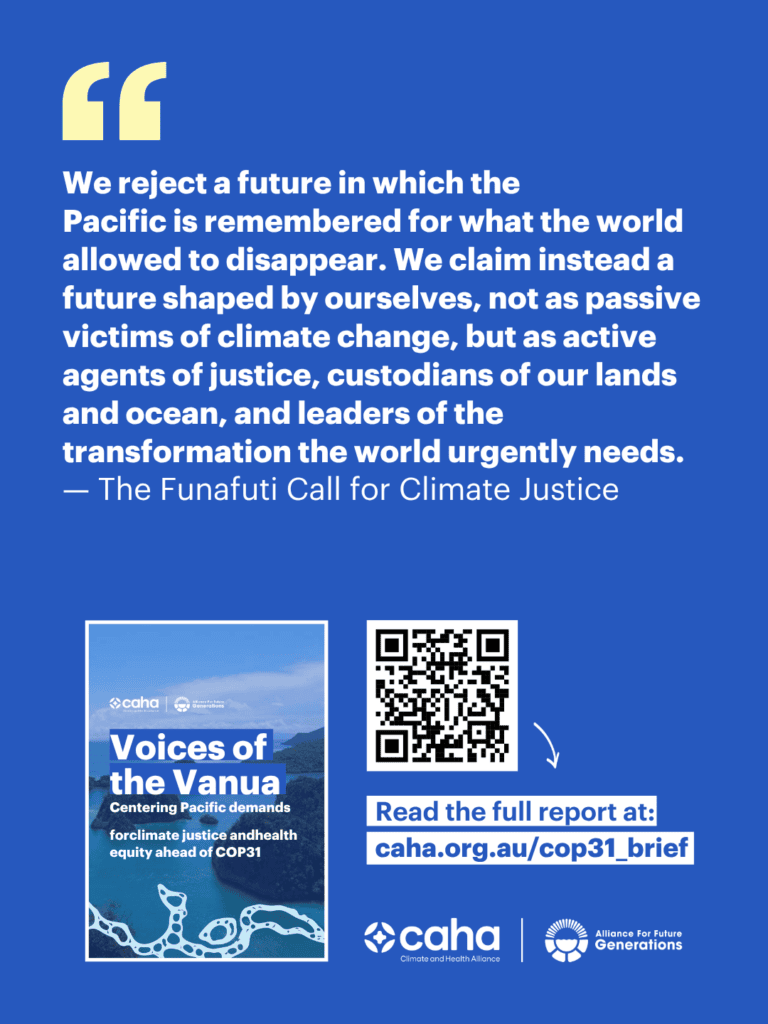
Lowitja Institute supports the priorities outlined in the Climate and Health Alliance’s recent policy brief, Voices of the Vanua: Centering Pacific demands for climate justice and health equity ahead of COP31, which outlines four core priorities identified by knowledge holders and leaders across the Pacific Islands, Australia, and Aotearoa.
This brief sets out policy priorities which uphold Pacific peoples’ legal rights to health, safety and culture. It aims to inform policy, financing and implementation decisions that deliver existing commitments, address gaps identified through evidence and lived experience, and strengthen accountability for results.
Read our full policy statement
Learn more about our work in climate change and health
Read the CAHA policy brief, Voices of the Vanua